

Florentina Voboril Presents her Latest Paper and Current Research at FLoC 2026
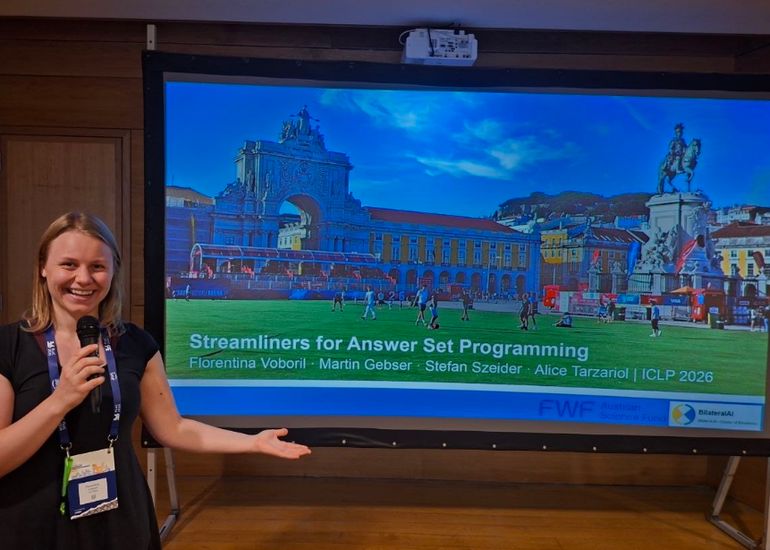
iCAIML PhD student Florentina Voboril presented her paper “Streamliners for Answer Set Programming” and current research “Improving Constraint Models with LLM Agents”.
About
From July 19 to July 23, Florentina Voboril attended the Federated Logic Conference (FLoC 2026) in Lisbon, Portugal, where she presented her latest paper, Streamliners for Answer Set Programming and introduced her current research on Improving Constraint Models with LLM Agents.
Florentina reflects on her experience:
“The conference was a great opportunity to meet researchers from around the world, exchange ideas, and discuss future collaborations. One particularly rewarding moment was seeing new research that builds on a paper I published last year. It is incredibly motivating to see your work inspire others. I’m returning from Lisbon with many new ideas, exciting connections, and plenty of motivation for the next steps in my research.”
Links
- FLoC 2026 Conference: https://www.floc26.org
- LLM-Solve Workshop: https://sites.google.com/view/llm-solve-2026
- Paper Streamliners for Answer Set Programming: https://cgi.cse.unsw.edu.au/~eptcs/paper.cgi?ICLP2026.19.pdf
Abstracts
Streamliners for Answer Set Programming
Streamliner constraints reduce the search space of combinatorial problems by ruling out portions of the solution space. We adapt the StreamLLM approach, which uses Large Language Models (LLMs) to generate streamliners for Constraint Programming, to Answer Set Programming (ASP). Given an ASP encoding and a few small training instances, we prompt multiple LLMs to propose candidate constraints.
Candidates that cause syntax errors, render satisfiable instances unsatisfiable, or degrade performance on all training instances are discarded. The surviving streamliners are evaluated together with the original encoding, and we report results for a virtual best encoding (VBE) that, for each instance, selects the fastest among the original encoding and its streamlined variants. On three ASP competition benchmarks (Partner Units Problem, Sokoban, Towers of Hanoi), the VBE achieves speedups of up to 4–5× over the original encoding.
Improving Constraint Models with LLM Agents
The runtime of Constraint Programming (CP) solvers is highly sensitive to modeling choices, such as symmetry breaking, implied constraints, global constraints, constraint reformulation, and variable representation. Improving these constraint models has traditionally required human expertise. We introduce an agentic framework in which an LLM agent, given the model and three training instances, autonomously decides which improvements to attempt, validates them empirically, and iterates over candidates to return the best one it identifies.
Our agent is based on a Large Language Model (LLM) that runs in a Reason and Act loop, with the ability to call tools (e.g., writing and executing Python code). It receives a CPMpy model and three small training instances as input, autonomously creates and tests alternative CPMpy models, and outputs the variant that it considers best-performing within about fifteen minutes. We then evaluate the proposed model on three larger test instances. We run this approach on nine constraint optimization problems, including well-known benchmark problems and a self-designed one. Our results show that the generated models outperform the original models on 20 out of 27 test instances (74%), demonstrating that autonomous agentic methods can support the improvement of constraint models.